CCUS in the EU/EEA
CCUS in the EU/EEA
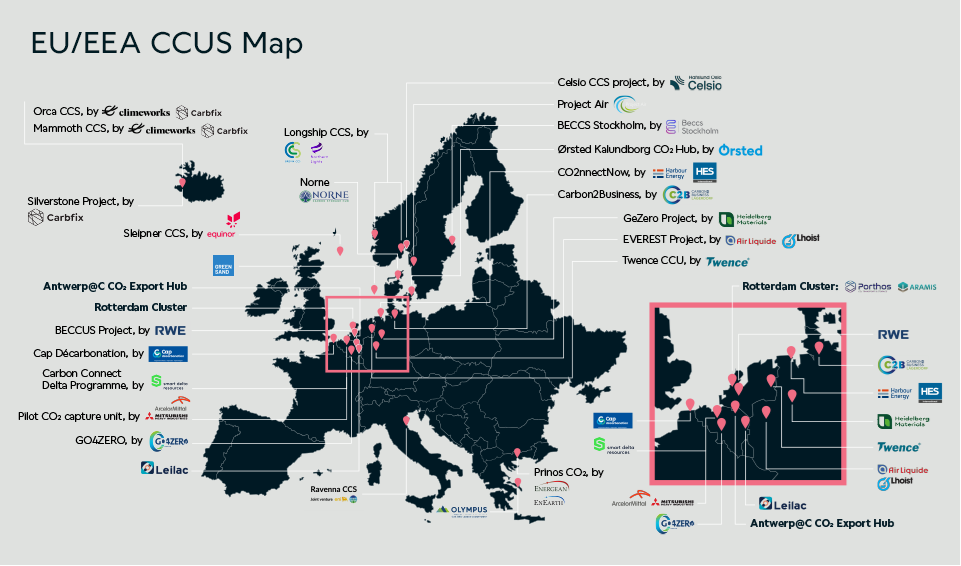
Europe has positioned itself as a leader in CCUS by integrating early North Sea projects with developing industrial hubs across Northern and Southern Europe, supported by the EU Industrial Carbon Management Strategy and funding from the Innovation Fund, Connecting Europe Facility (CEF) under TEN-E, and Horizon Europe. These initiatives increasingly form cross-border clusters targeting hard-to-abate sectors like cement and chemicals to advance the EU’s climate neutrality goal by 2050 and the proposed 90% emissions reduction target for 2040.
From Sleipner to Hubs
The Sleipner project at Equinor’s offshore gas facility in the Norwegian North Sea stands as the first large-scale dedicated CO₂ storage operation with continuous monitoring, starting in 1996. It separates CO₂ from produced gas and injects it into the Utsira saline aquifer about 1 km below the seabed, having stored more than 19 million tonnes of CO₂ by the end of 2020. Sleipner offers a proven technical and regulatory model for North Sea storage expansions.
Northern Europe features interconnected CCUS hubs around the North Sea, leveraging shared storage and shipping for cross-border CO₂ value chains. These projects target sectors like cement, refineries, chemicals, hydrogen, waste-to-energy, and steel, evolving into open-access networks.
Norway: Longship and Northern Lights
Longship integrates capture from Norcem Brevik cement and Oslo waste-to-energy with Northern Lights, an open-access transport and storage system operational since 2025 at initial capacity of 1.5 MtCO₂/year, scaling to 5 MtCO₂/year in phase 2 from 2028. Northern Lights has agreements for cross-border storage, including up to 0.8 MtCO₂/year from Yara Sluiskil (Netherlands) starting 2025 and 0.43 Mt biogenic CO₂/year from Ørsted plants (Denmark) from 2026.
Netherlands: Porthos and Aramis
Porthos in Rotterdam captures CO₂ from industries, transports via pipeline to depleted North Sea gas fields, and stores ~2.5 MtCO₂/year for 15 years (total 37 Mt); construction started 2024, operational 2026, designated a TEN-E Project of Common Interest. Aramis expands offshore storage for Dutch and neighboring industries, with Dutch government investing €639 million in 2025 to support development toward 2027 operations.
Denmark and Sweden
Denmark’s Greensand stores CO₂ in North Sea fields, demonstrated cross-border shipping in 2023, targeting 0.4 MtCO₂/year by 2025/26 and up to 8 Mt/year by 2030. Sweden’s BECCS Stockholm captures up to 0.8 Mt biogenic CO₂/year from district heating at Värtan, shipping to Northern Lights for storage, with operations from 2028.
CCS in the Mediterranean
Southern and Mediterranean Europe are also advancing CCUS, utilizing offshore depleted gas fields and industrial clusters in Italy and Greece. These efforts complement North Sea developments, enabling decarbonization for energy-intensive industries continent-wide.
Italy: Ravenna CCS Hub
The Ravenna CCS Hub, operated by Eni and Snam in the Adriatic offshore gas fields, started Phase 1 injection in 2024 at 0.25 MtCO₂/year from Eni’s Casal Borsetti plant. Phase 2 targets 4 MtCO₂/year by 2030, with potential expansion to 16 MtCO₂/year post-2030, serving northern Italy and Mediterranean emitters.
Italy-Greece: HERCCULES Project
HERCCULES, funded by Horizon Europe with €29.6 million EU contribution (total budget €39.6 million), demonstrates full CCUS chains for cement in Greece and cement plus energy-from-waste in northern Italy. Launched January 2023 for 60 months, it pioneers Southern Europe deployment, leveraging local transport and storage initiatives.
EU-level Support and Funding Architecture
The EU ICM Strategy integrates CCUS and carbon removal into the Green Deal, targeting 280 MtCO₂ capture by 2040 and 450 Mt by 2050 to meet the 90% reduction goal for 2040 and climate neutrality by 2050.
EU ETS and Innovation Fund
EU ETS delivers the carbon price incentive for CCUS, while the Innovation Fund has granted over €3.3 billion to 26 industrial carbon management projects as of 2024, including large-scale cross-border hubs.
TEN-E and CEF Energy
Revised TEN-E Regulation designates CO₂ networks as Projects of Common Interest or Mutual Interest, unlocking CEF funding; CEF has invested over €978 million in 28 CO₂ transport projects since 2019, with €240 million more in 2025 for 10 projects.
Horizon Europe and Other Finance
Horizon Europe funds R&I with ongoing support for ICM technologies. Additional measures include EIB cooperation, potential IPCEIs alongside national grants and reforms for cross-border CO₂ services.
Accelerating a Europe-wide CO2 storage market
This CCSA report, based on modelling and analysis by Xodus Group – is clear: enabling cross-border CO2 transport and storage is critical for reducing emissions efficiently and on time. The European Commission and national governments can make this a reality. Expanding the CO2 market across Europe, including the UK, is an effective way to lower emissions and storage costs. As of right now, policy remains the largest obstacle to transporting CO2 across the EU-UK border, which would otherwise be technically feasible.