Low-carbon products: securing industry, jobs and competitiveness
Industries for Growth
The materials behind every home, road, bridge, wind turbine and energy system do not appear by accident.
They come from foundational industries that have powered regional economies for generations — producing the cement, steel, fuels, chemicals and other materials that underpin modern life.
The challenge now is clear: how do we keep these industries competitive while reducing emissions?
Creating demand for low-carbon products is a critical part of the answer.

The industries behind everyday life
Foundational industries support jobs, supply chains and economic resilience across the UK and Europe.
Across the EEA (European Economic Area), this includes around 200 cement plants, around 500 steel production sites across 22 countries, and 66 refineries.
Together, these industries support hundreds of thousands of jobs and provide the essential materials used across infrastructure, manufacturing and clean energy systems.
major UK refineries
UK cement plants
UK steel plants
steel production sites across Europe
What they produce
Foundational industries provide the essential materials used across infrastructure, manufacturing and clean energy systems.

Cement
& lime

Steel

Glass

Fuels
& feedstocks

Chemicals
Plastics
Low-carbon products: securing the future
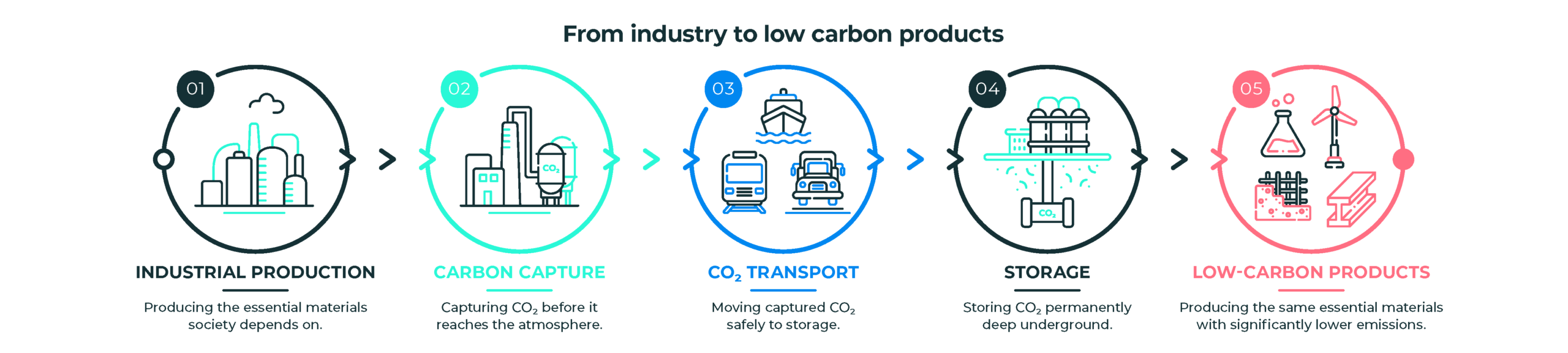
Low-carbon products are the same essential materials and energy products — produced with significantly lower emissions.
Examples include low-carbon cement, low-carbon steel, low-carbon chemicals, sustainable aviation fuel, low-carbon hydrogen and dispatchable low-carbon power.
These are not niche products. They will be essential to delivering new infrastructure, clean energy projects, housing and modern manufacturing while maintaining domestic industrial capability.

Why CCUS matters
Many industrial processes require extremely high temperatures and continuous operation. For sectors such as cement, lime, chemicals, refining and glass manufacturing, emissions cannot be eliminated through electrification alone.
CCUS plays a critical role in enabling low-carbon production at scale while supporting industrial competitiveness.

Reducing
industrial emissions

Enabling
low-carbon production at scale

Supporting
low-carbon fuels and hydrogen

Protecting
jobs and competitiveness
All credible pathways to net zero recognise a role for carbon capture in heavy industry.
Demand creates investment
Producing low-carbon products is only part of the challenge.
Industry also needs confidence that there will be customers willing to buy them.
Key buyers include governments through procurement, infrastructure and energy developers, airlines and transport operators, manufacturers and large corporates.
Creating demand gives industry the confidence to invest

What needs to happen
The UK and Europe already have the industries, skills and projects needed to move forward. What is needed now is market certainty.
Priority actions
- Create demandPublic procurement of low-carbon products, clear product standards and definitions, and green lead markets can help create confidence that low-carbon products will have customers.
- Enable investmentLong-term policy certainty, stable regulatory frameworks and support for industrial decarbonisation projects can help unlock investment decisions.
- Deliver infrastructureTimely deployment of CO₂ transport and storage networks, coordinated industrial planning and clear routes to market for CCUS are essential to scale low-carbon production.
What this delivers
Protect industrial jobs
Supporting low-carbon production helps protect skilled jobs in foundational industries and creates opportunities across regional supply chains.
Strengthen resilience
Clear demand for low-carbon products can reduce reliance on higher-carbon imports and support long-term industrial resilience.
Reduce emissions
Low-carbon products can help deliver new infrastructure, clean energy projects, housing and modern manufacturing while reducing industrial emissions.
Why this matters
Low-carbon products are not simply a climate issue. They are central to industrial competitiveness, economic growth and long-term resilience.
Take action
Support the development of strong UK markets for low-carbon industrial products.
CCUS: Building a low-carbon future
Watch our Greener UK series episode on how CCUS can support a competitive, low-carbon industrial future.