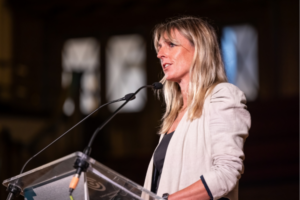
CCUS Conference 2026: From Ambition to Deliver - Olivia Powis Opening Speech
 Add to favourites

CCUS Conference 2026: From Ambition to Deliver - Olivia Powis, CEO, Opening Speech
London, 13 October 2026 –
Good morning, everyone, and welcome to CCUS 2026 – From Ambition to Delivery”
It is wonderful to see so many colleagues, partners and friends from across industry, government, finance and academia.
We are joined by delegations and speakers from across the UK, Europe and beyond, including from Norway, Denmark, Germany, Greece, The Netherlands, Malaysia and Australia.
Thank you to all of our sponsors – particularly our Gold sponsors; Carbon Clean, Shell, Spirit Energy, Technip Energies and Shell Catalysts & Technologies Alliance.
All of our sponsors will be exhibiting during the coffee and lunch breaks in the Lecture Hall and Library.
I would also like to thank Eni CCUS Holding Ltd for sponsoring the Networking Lounge again this year – with excellent coffee!
And thank you to Judy and the CCSA team for all their work in putting this event together.
And please do join us later today for our drinks reception and the inaugural International CCUS Awards Dinner, which I am delighted to say is completely sold out.
But now, to today’s theme: From Ambition to Delivery.
And looking back over the past year, that feels less like an aspiration and more like a description of what is happening.
Because in 2026, delivery became real!
For years, CCUS existed largely in policy papers, consultations and investment plans.
Today, it exists in operating facilities, construction sites and supply chains.
Across Europe, projects are capturing, transporting and permanently storing CO₂.
Just in the last month Yara’s facility at Sluiskil in the Netherlands has commenced operations.
And In Denmark, Greensand Future inaugurated the EU’s first cross-border commercial CCS value chain.
And in Norway, Brevik continues to demonstrate what industrial-scale carbon capture can achieve, storing its CO₂ with Northern Lights.
These are not isolated projects.
They are the foundations of a connected European CCUS industry.
And here in the UK, construction is now underway and creating economic opportunities.
Liverpool Bay CCS and the Northern Endurance Partnership have together awarded more than £4 billion of contracts to over 350 UK companies, delivering more than 50% UK content.
Last week, Liverpool Bay CCS completed installation of the Douglas CCS platform, the first purpose-built offshore platform dedicated to industrial carbon storage.
Northern Endurance Partnership have today published their Progress and Impact Report for the East Coast Cluster, highlighting the benefits of the CCUS industry, including awarding £2.1 billion to UK suppliers and supporting more than 3,000 jobs during construction and seeking to further that with expansion on Teesside and into the Humber.
Construction is advancing at the UK’s first three capture projects; at Padeswood cement plant in north Wales, Encyclis’ Protos energy-from–waste facility in Cheshire and at Net Zero Teesside Power in the North East.
And engineers in Teesside, fabricators in Hartlepool, construction workers in north Wales and businesses across the country are already helping to build this industry.
This is what reindustrialisation looks like.
It is not a slogan, it is concrete being poured.
Pipelines being manufactured and laid,
Platforms being installed.
And skilled jobs being created with economic opportunities across the UK.
But these projects are only the beginning.
Across every industrial region of the UK, projects are preparing to move forward.
The HyNet Expansion and East Coast Cluster Selection projects await progress decisions from the Government, as well as Viking CCS, the Acorn Project, East Coast Cluster Humber Expansion, and MNZ | Peak, Bacton CCS, the Poseidon Project, Exolum 7CO2, South Wales Industrial Cluster, Veri and Solent.
They represent billions of pounds of investment, thousands of jobs, and industries that need a route to decarbonise and remain competitive – to provide our future energy and product security.
And that is why continued commitment matters.
Because we should be clear: This momentum is not inevitable.
The first projects have created confidence because governments made commitments and industry invested against them.
If that commitment weakens now, investment and developers will not simply wait. They will go elsewhere.
The UK has worked hard to establish itself as a global leader in CCUS.
We cannot afford to lose that position just as delivery begins.
The potential for this industry is enormous – and if we are to meet our climate ambitions – it is essential.
Any failure to deliver on previous spending commitments would not just jeopardise projects already underway – it will damage UK growth and delivery of reindustrialisation.
Meanwhile, progress is broadening across Europe.
Projects are under construction with Stockholm Exergi’s carbon removal project in Sweden and Porthos in Rotterdam. New storage hubs are emerging in the Baltic and Mediterranean regions across France, Greece and Italy with the Ravenna project progressing and Prinos store receiving its storage permit. And governments are increasingly working together to unlock cross-border CO₂ transport and storage with the Baltic Energy Initiative and Callisto Mediterranean CO2 Network.
We have also seen new funding opportunities created across Europe and interest to invest, with the EU’s recent announcements of the €30bn investment Booster, as part of the €100bn Industrial Decarbonisation Bank and carbon contract for difference rounds launched this year in Germany, France and Denmark.
These developments are very important to build the first projects and address the complex cross-chain risks.
The UK’s Humber Capture Project Market Survey also demonstrated clear demand, while the East Coast Cluster Teesside Selection Process and NPT pathfinder were both over-subscribed. And UK developers applied for rights covering more than 2 million acres of seabed in the latest NSTA carbon storage licensing round.
The level of interest and engagement from industry, investors and Member States is real.
But building projects is only part of the challenge.
The next challenge is building markets. And here too, we are seeing encouraging signs.
The CCSA has developed thought leadership and is driving policy to develop carbon credit markets and, low carbon product and power markets, including data centres.
Governments are beginning to procure carbon removals, The City of Stockholm, will purchase 50,000 T/yr of permanent carbon removals for 15 years. The EU buyer’s club for a Carbon Dioxide Removal purchase programme was launched in May of this year. And the UK’s first public procurement of CDR credit was purchased last month.
These commitments will help to drive private markets, where we have already seen more than 50 million tonnes of carbon removals have now been contracted globally.
And low-carbon product markets are emerging.
Brevik’s first year of near-zero cement production was effectively sold before production had fully ramped up. And Padeswood capture facility is being constructed with EvoCement.
That sends an important signal.
Customers want low-carbon products.
Our job now is to scale those markets.
We are also seeing growing momentum for cross-border cooperation.
The CCSA has been active in pushing for EU-UK negotiations to advance as quickly as possible and has shown that a larger, more competitive storage market will reduce costs for emitters.
So, we were pleased to hear that the EU and UK ETS linkage agreement is on a positive trajectory towards the forthcoming EU-UK Summit – formally announced yesterday for 20 November.
And earlier this year I was delighted to witness the UK signing its first bilateral agreement with Belgium under the London Protocol – which signalled an important milestone.
Norway, France, Belgium, Germany, Denmark and the Netherlands have all recently signed bilateral agreements to advance cooperation on CO₂ transport and storage.
All of this points in one direction:
A more connected, more competitive European CCUS market.
But none of this progress has happened in easy circumstances.
We are operating in a world of geopolitical uncertainty, changing political leadership and trade relationships, high energy costs and intense pressure on public finances.
At the same time, political and public support for net zero is increasingly contested.
But these pressures do not weaken the case for CCUS.
They make it stronger than ever.
This summer provided another reminder of why.
Europe – now the fastest-warming continent, warming at more than twice the global average rate – experienced its hottest July on record, with heat, drought and wildfires affecting communities, agriculture, water supplies and energy production.
These impacts are not distant. And neither is industry’s responsibility.
Industry accounts for around a quarter of direct global greenhouse-gas emissions, rising to roughly a third when the power and heat it uses are included.
For cement, chemicals, fertilisers, energy-from-waste and other essential industries, there is simply no credible route to deep decarbonisation without CCUS.
It is an essential tool alongside efficiency, electrification, clean fuels and a circular economy.
The challenge facing Europe is not how to choose between climate action, defence, economic growth, industrial competitiveness or energy security.
It is how to deliver all of them together.
And ultimately, this is about people.
Earlier this year, the CCSA brought 18 apprentices and graduates from 8 industrial regions to UK Parliament.
They met the Energy Minister and spoke about the careers they are building in this sector.
One young participant said something that has stayed with me: “CCUS is the future, and we are the ones building it.”
That is exactly what this industry represents.
A chance to create and protect skilled jobs.
A chance to give industrial communities a genuine stake in reindustrialisation.
A chance to ensure the products, infrastructure and expertise needed for a low-carbon world are built here in the UK and across Europe.
And the CCSA has a vital role to play in delivering this – from both our UK and Brussels offices.
We bring together the people who can make this future possible across industry and government, regulators and agencies, investors and innovators, workers, regions and international partners.
Together these people can enable CCUS to deploy at scale and commercialise.
So let us use these next two days well. The theme of this conference is From Ambition to Delivery.
Over the past year, we have shown that delivery is possible.
Now we must prove it is scalable.
We must complete the first projects.
We must unlock the next wave of investment.
We must build the markets that allow this industry to thrive.
Because the momentum is real.
And the prize is enormous.
Industrial competitiveness.
Economic growth.
Energy security.
Skilled jobs.
And emissions reduction at scale.
The question is no longer whether CCUS will happen.
The question is where and how quickly.
Our job is to make sure we know the answer.
Thank you.