Scottish and Viking Clusters join the UK Government CCUS Programme

Menu

Archive for the ‘CCSA News’ Category

Scottish and Viking Clusters join the UK Government CCUS Programme

Posted on: July 31st, 2023 by ccsaEditor

31st July 2023, London

The Carbon Capture and Storage Association (CCSA), the trade body for the Carbon Capture, Utilisation and Storage (CCUS) industry in Europe, welcomes today’s announcement from the UK Government regarding the selection of the next two CCUS clusters in the UK to be built by 2030.

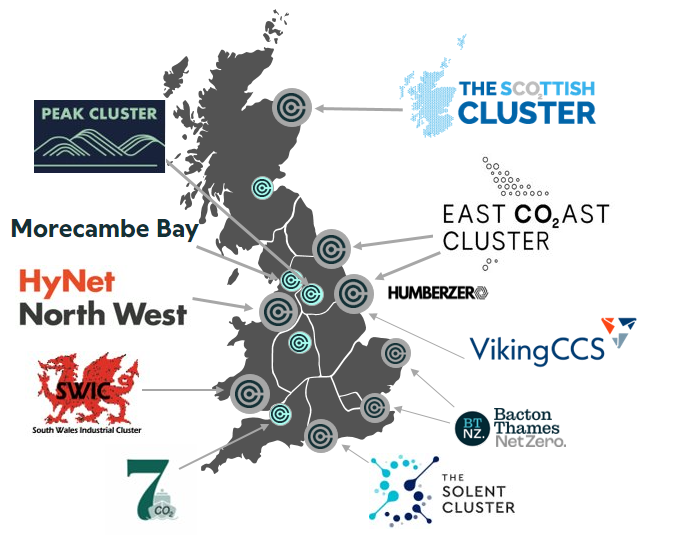
The Government has today announced that the Scottish Cluster and the Viking cluster in the Humber, will move forward to the next stage of deployment as ‘Track 2 clusters’, as part of the Government’s CCUS cluster sequencing programme. These clusters have the potential to reduce carbon dioxide emissions by up to 19 million tonnes collectively, thereby making a significant contribution to the Government’s ambition to store 20-30 million tonnes of carbon dioxide by 2030, as well as helping to put the UK on a pathway to storing over 50million tonnes a year by 2035, in line with its Net Zero Strategy.

Ruth Herbert, Chief Executive at the CCSA, said:

“We are pleased to see the UK Government pushing ahead with its CCUS deployment programme and selecting the next two CCUS clusters, as time is running out to meet 2030 targets. This CO2 infrastructure is critical to safeguarding the UK’s supply chain security, enabling local industries to continue to thrive whilst reducing their emissions as we transition to a net zero economy.

It is therefore vital that the Government urgently sets out clarity on the process and timeline for selecting carbon capture sites within these ‘Track-2’ clusters and within the previously announced Track-1 cluster expansion.  Billions of pounds of investment is waiting to be deployed to decarbonise these industrial regions, but firm plans are required to secure it.

There are a number of other clusters under development across the country, which is why last year we asked government for visibility of the longer-term CCUS deployment plan. Collectively, CCUS clusters could protect 77,000 current jobs and create a further 70,000 jobs across the UK. Government’s forthcoming vision for the UK CCUS sector needs to be published as soon as possible, to avoid investment flight in those regions that have not been selected today.”

Dr Nick Cooper, CEO of Acorn lead developer Storegga, said:

“We are thrilled that the Acorn Project has advanced directly into Track-2. Acorn has been progressed by the development partners as the Track-1 reserve since late 2021 and is ready to move promptly to support the decarbonisation of Scotland and the wider UK.

“Today’s news is a defining milestone for us, and the Scottish Cluster. Acorn will be a major contributor towards meeting the UK and Scotland’s carbon reduction targets, able to serve emitters connected by pipeline and ship.

“As Lead Developer, Storegga thanks Acorn partners and Scottish Cluster participants for their support and we look forward to working with Government to deliver the multiple benefits of creating and future-proofing jobs, bringing inward economic investment, developing green-tech industries and, crucially helping decarbonise Scotland and the UK.”

Harbour Energy’s Executive Vice President of Net Zero and CCS Steve Cox said:

“The successful award of Track 2 status to Harbour’s Viking CCS project in the Humber as well as Acorn in northeast Scotland is another demonstration of how we are well positioned to use our existing skills and infrastructure to help develop the burgeoning CCS industry in the UK.

“More widely, the announcement today shows the key role the North Sea oil and gas sector will play in helping to deliver the UK’s carbon capture goals.”

ENDS

Notes to Editors

CCUS, or Carbon Capture, Utilisation and Storage, is a key low carbon solution – vital to meeting the UK’s statutory Net Zero target at least cost. CCUS enables the production of clean power, clean products (such as steel and cement) and clean hydrogen – which can then be used to decarbonise heating and transport. In addition, CCUS also enables greenhouse gas removal from the atmosphere through Direct Air Capture with Storage (DACS) or Bioenergy with CCS (BECCS).

The CCSA is the lead European association accelerating the commercial deployment of CCUS. We work with members, governments and other organisations to ensure CCUS is developed and deployed at the pace and scale necessary to meet net zero goals and deliver sustainable growth across regions and nations.

The CCSA currently has over 100 member companies who are active in exploring and developing different applications of carbon capture, CO2 transportation by pipeline and ship, utilisation, geological storage, and other permanent storage solutions, as well as members from management, legal and financial consulting sectors.

For media enquiries please contact +44 (0)20 3031 8750 or email info@ccsassociation.org

To find out more about the Carbon Capture Storage Association (CCSA) please visit the CCSA website at http://www.ccsassociation.org/.
CCSA Position Paper on Storage Obligations Schemes

Posted on: July 20th, 2023 by ccsaEditor

This is the CCSA’s latest position on carbon storage obligations. Building on our previous outputs in this area and following discussion with CCSA members, we have today:

Download the paper here.

CCSA paper – Storage obligations

CCSA Launches New CCUS Supply Chain Strategy

Posted on: July 12th, 2023 by ccsaEditor

New Carbon Capture Supply Chain Strategy calls for coordinated action from UK Government and industry to create a new homegrown industry and support tens of thousands of jobs

The Carbon Capture and Storage Association (CCSA), the trade body for the Carbon Capture, Utilisation and Storage (CCUS) industry in Europe, is today launching a CCUS Supply Chain Strategy which sets out a number of actions to deliver a successful CCUS industry that has the potential to safeguard 77,000 existing jobs in heavy industries such as steel and cement, while creating 70,000 new jobs in the green economy.

The CCSA has launched the strategy jointly with the CCUS Council Supply Chain Working Group, chaired by Make UK Chairman Lord Hutton. The working group advises ministers on deploying and scaling up carbon capture technology.

In order to achieve a target of 50% UK content in the manufacturing, goods and services underpinning new carbon capture and storage technology the Supply Chain Strategy sets out three key actions for Government and industry during the early phase of subsidised deployment:

  1. A clear timetable for when and where government support will be allocated to capture projects to drive confidence and raise the profile of the sector,
  2. Flexibility in bilateral negotiations on cost and delivery dates where there is an opportunity to secure higher UK content; and

Today’s strategy includes a Good Practice Guidance document for industry which, provided the above actions are met, sets out a pathway for delivering the UK content ambition. This guidance is aimed at supporting developers and contractors to build local supply chains by improving planning and engagement at an early stage and throughout the procurement process.

The guidance document covers six key areas of focus:

The CCSA is also today submitting a paper on CCUS skills into the Green Jobs Delivery Group, which was convened by the Government to support the creation of almost half a million green jobs by 2030. The “CCSA Workforce & Skills Position Paper” sets out the strong linkages between developing the CCUS supply chain and skills and highlights the need for urgent action to coordinate the skills requirements across the entire low carbon economy.

Ruth Herbert, Chief Executive at the CCSA, said:

“The report published today at our President’s Reception emphasises the massive opportunity that CCUS represents for the UK. Our strategy concludes that developing a UK CCUS supply chain, together with skills and training programmes, is urgently needed to decarbonise our heavy industries and protect jobs in regions such as Yorkshire & Humber, Wales, the North-West of England and the North-East of Scotland.

“The prize is significant – the opportunity for the UK to access a multi-billion-pound global supply chain market for CCUS equipment, goods and services, as well as the creation of over 70,000 new UK jobs whilst safeguarding up to 77,000 jobs in carbon-intensive industries at risk of being relocated abroad.

“This strategy requires Government to target investment on manufacturing yards which have the potential to supply high value items to the CCUS industry and will be delivering multiple large strategic infrastructure developments over the next decade. From the industry’s side, by following the guidance we aim to improve the transparency of the procurement process and ensure that local supply chain engagement is prioritised from early on in the development cycle.”

Lord Callanan, Parliamentary Under Secretary of State (Minister for Energy Efficiency and Green Finance), said:

“A successful UK supply chain is key to sustaining existing, and creating new, high-skill, high-value green jobs and supporting growth in industrial clusters.

“To achieve this, industry and government must work together and today’s new report from the Carbon Capture and Storage Association is a crucial step forward to harnessing the full potential of Britain’s CCUS industry.”

Lord Hutton, Chair of Make UK and Chair of the CCUS Council Supply Chain Working Group, said:

“It’s encouraging to see the CCUS industry take the lead in developing supply chain guidance and if projects follow this guidance, together with Government providing strong support, then a reliable, high quality and secure domestic supply chain can be achieved.”


ENDS

Notes to Editors

On the 12th July, the CCSA published two documents which can be found below.

The Supply Chain Strategy and Good Practice Guidance Document is a joint study between the CCSA Supply Chain Working Group and the CCUS Council Supply Chain Working Group. The following organisations contributed to this study:

CCUS, or Carbon Capture, Utilisation and Storage, is a key low carbon solution – vital to meeting the UK’s statutory Net Zero target at least cost. CCUS enables the production of clean power, clean products (such as steel and cement) and clean hydrogen – which can then be used to decarbonise heating and transport. In addition, CCUS also enables greenhouse gas removal from the atmosphere through Direct Air Capture with Storage (DACS) or Bioenergy with CCS (BECCS).

The CCSA is the lead European association accelerating the commercial deployment of CCUS. We work with members, governments and other organisations to ensure CCUS is developed and deployed at the pace and scale necessary to meet net zero goals and deliver sustainable growth across regions and nations.

The CCSA currently has over 100 member companies who are active in developing and deploying different applications of carbon capture, CO2 transportation, utilisation, geological storage, and other permanent storage solutions, including end-users from the power and industrial and hydrogen production sectors and members from management, legal and financial consulting sectors.

For media enquiries please contact Judith Shapiro on +44 (0)20 4583 2295 or email judith.shapiro@ccsassociation.org

To find out more about the Carbon Capture Storage Association (CCSA) please visit the CCSA website at http://www.ccsassociation.org/.

CCSA CCUS Supply Chain Good Practice Guidance

CCSA Supply Chain Good Practice Guidance – Summary

UK CCS Supply Chain Value Study

CCSA Workforce & Skills Position Paper

Posted on: July 12th, 2023 by ccsaEditor

The CCSA has today published a new “Workforce & Skills Position Paper”.

This position paper has been produced by the CCSA Skills & Training Task Subgroup, operating under the CCSA Supply Chain Working Group. Its purpose is to present the CCSA’s stance on and understanding of the skills and workforce challenges that are currently facing the Carbon Capture, Utilisation and Storage (CCUS) sector. It offers a high-level overview of the existing skills and training landscape for the CCUS and low carbon hydrogen workforce, encompassing jobs across the entire value chain from capture to transport & storage during the construction and operational phases. This includes an examination of the skills and training obstacles faced by the current workforce, as well as those who are currently in the education system and will constitute the future workforce.

The UK CCUS and Carbon Capture and Storage (CCS) enabled low-carbon hydrogen sector is encountering a scarcity of skilled personnel, particularly in design and engineering construction. This shortage has the potential to significantly impede the timely completion of CCUS projects and have adverse effects on the UK’s Net Zero objectives. The competition for skilled labour not only exists within the CCUS sector but also extends to other large-scale infrastructure projects who require the same skilled workforce to deploy across the UK within similar timeframes. The need to replace or re-train an ageing and non-diverse workforce, along with the challenge of attracting a significant number of school and college graduates to an industry that may not be perceived as glamorous, further intensifies the urgency of attracting and training new workers. The position paper outlines a series of crucial recommendations that are key to ensuring the availability of resources to facilitate the transition to Net Zero through the implementation of CCUS.

CCSA Workforce & Skills Position Paper

CCSA Workforce & Skills Position Paper – SUMMARY

CCSA comments on the Climate Change Committee’s 2023 Progress Report to Parliament

Posted on: June 28th, 2023 by ccsaEditor

The Carbon Capture and Storage Association (CCSA), the trade body for the Carbon Capture, Utilisation and Storage (CCUS) industry, welcomes the Climate Change Committee’s 2023 report to Parliament on progress in reducing emissions, published today.

Ruth Herbert, Chief Executive at the CCSA, said:

“This report makes clear that the UK must get moving and accelerate deployment of CCUS to have any chance of reaching our net zero targets. The CCC spell out that there is currently no clear policy for UK industries to decarbonise. CCUS offers an opportunity to decarbonise heavy industry, while protecting and creating jobs.

“We urgently need a CCUS deployment plan for the whole of the UK.  We’re still waiting for contracts to be signed for the first eight carbon capture projects, and for ministers to confirm the next steps on expanding the clusters on the east coast and north west of England, as well as a timeline for selecting further clusters in other parts of the UK, which is necessary to meet the Government’s ambition of four CCUS clusters by 2030.”


For media enquiries please contact Judith Shapiro at judith.shapiro@ccsassociation.org/ Tel: +44 (0)20 4583 2295

CCSA Blog: Recent CCUS announcements and delivering the next wave of clusters in the UK, by Ruth Herbert, CCSA CEO

Posted on: May 25th, 2023 by ccsaEditor

At the CCSA we’ve been taking some time to reflect on the momentous announcements over the past few weeks. I’m delighted to finally see the decades of hard work and collaboration between industry and government come to fruition. This is a pivotal moment which fires the starting gun on the UK CCUS industry. 

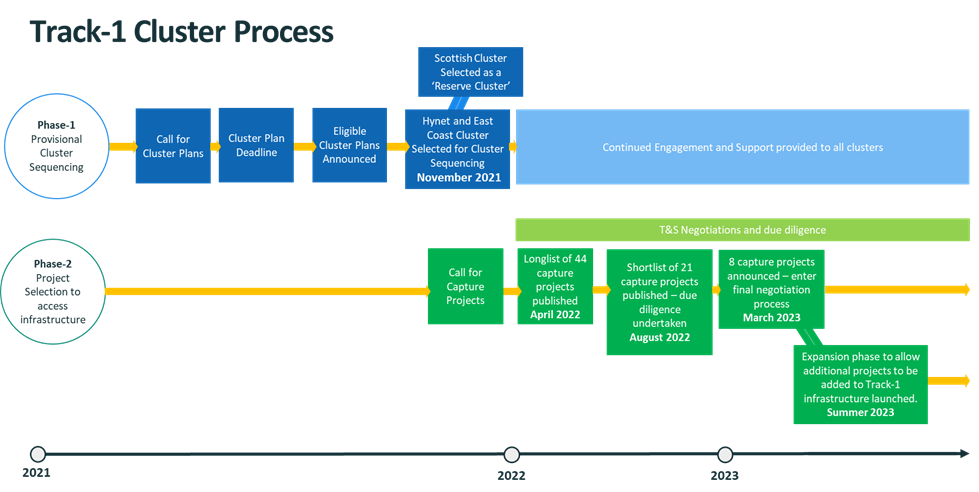
The Government’s Spring Budget announced £20billion of funding had been allocated for CCUS projects, an unprecedented recognition of the importance of CCUS in delivering net zero and boosting the UK’s economic growth. The funding means the initial Track 1 CCUS clusters can truly start moving forward with the first eight projects – a critical springboard for the UK industry to further develop and a kickstart for the decarbonisation of North-West and East Coast of England. The funding will provide operational payments to cover the use of carbon capture on power, industry and hydrogen production and this will unlock private sector capital for its construction.  These eight projects will collectively capture and store around seven million tonnes of CO2 a year and create thousands of jobs.  

These projects are just a small proportion of what is required to reach Net Zero. But they represent just one tenth of the current project pipeline, demonstrating the scale of the opportunities in front of us.  Last year the CCSA identified over 70 million tonnes of carbon emissions from around the UK which could be abated with Carbon Capture and Storage by 2035. Delivery of all of these projects would keep the UK on track with its Net Zero Strategy trajectory and provide significant economic benefits to disadvantaged regions.  

Critically, this is not just a Net Zero opportunity. The CCUS pipeline can provide 70,000 new jobs, as well as protecting 77,000 existing jobs, across the UK’s industrial heartlands, all while positioning our country to export low carbon products and CCUS skills and services around the globe. There is more to do and the necessary next steps are set out in Chris Skidmore MP’s Net Zero Review recommendations 

We urgently need to see a clear CCUS deployment plan for the whole of the UK. To have a fighting chance of reaching Net Zero and leading the low carbon industries of the future, it is vital all of the industrial clusters across the UK get up and running with carbon capture and storage as soon as possible. 

Delivery of this plan offers an exciting, near-term opportunity to put our industrial regions at the forefront of the next industrial revolution – leading the way in the transition to a global low carbon economy in the same way as British industry led the world in the first industrial revolution. So great is this opportunity – the kind that only comes every few hundred years – other countries are racing to take up the mantel. Both the US Inflation Reduction Act and the EU’s Green Industrial Plan and Net Zero Industry Act set out powerful CCUS measures.  We risk falling behind despite the UK’s 18-year head start (the CCSA was established in 2006).   

We need a longer-term commitment to remain an attractive proposition to investors and to develop our own supply chain. Ahead of the Spring Budget, the CCSA made a Budget Submission requesting funding to cover the period to 2035. We believe this would provide sufficient forward visibility to develop a UK-based supply chain capable of both servicing the UK project pipeline and exporting technology and services to other emerging CCUS markets. We will keep up the pressure on the Government to deliver this. 

The recently announced Track 1 expansion will provide an important opportunity for the remaining shortlisted projects, as well as new projects. The expansion will launch later this year and government is expected to engage with the sector on delivery shortly. We urgently need to see more detail before the summer regarding the timeline for the expansion, the eligibility criteria, and what the industry can expect going forward. 

The Track 2 process for the next two CCUS clusters was also launched at the end of March. It’s important this process moves forward quickly if the UK is to meet its 2030 target of storing up to 30 million tonnes of CO2 a year. However, we are still awaiting further details on the timeline and criteria for selecting capture projects under Track 2.  

The Chancellor has said he will be setting out the UK’s response to the US Inflation Reduction Act and the EU Net Zero Industry Act this Autumn. While I am relieved to hear the UK will not sit back and shrug its shoulders as good people and projects leave the UK, the question on everyone’s lips is “can he afford to wait that long?”. Boards are already impatient to see the case for continued and new investment here in the UK. It is time for the government to set out its stall – persuasively – and action a swift response: every week counts in the race to build this industry. 

There is a powerful case to make. The UK is blessed with significant CO2 storage capacity in the North Sea and the East Irish Sea, and a strong offshore skills base, both of which make us uniquely placed to become one of the global leaders on CCUS deployment.  Critically for long term planning, there is widespread political consensus around CCUS’ vital role in reducing industrial emissions and enabling a Net Zero power system, as evidenced by the recent second reading of the Energy Bill in the House of Commons. The Bill provides an investable regulatory framework for CO2 transport and storage and world-leading carbon capture business models that minimise subsidy and provide long-term contractual certainty to investors.   

All that is needed to create a haven for CCUS development is an injection of confidence to take the big decisions, to accept some inevitable risks and to set aside any philosophical discomfort with the “build it and they will come” approach which is being pursued elsewhere.  The UK has developed a strong framework for a new industry – it just needs to turn on the funding tap and watch the inward investment flood in.   

The counterfactual of continuing to constrain the roll-out of CCUS through extended allocation processes will slam the brakes on the UK economy as private investment across a range of key ‘economic lifeblood’ sectors, such as manufacturing, energy and transport is either put on hold or finds another home.  Where civil servants and regulators need more resources to move at pace they should be given them, and quickly.  There is no option for the UK economy to stand still in this global race for the ‘once in a century opportunity’ – we have to speed up or we will be left behind. 

The UK’s CCUS policy has made tremendous progress in the past few months. I’m thrilled the industry is finally able to advance towards delivering the first eight projects on the ground. It really does feel like the official beginning of CCUS implementation in the UK.   

Just think what could be achieved with a bit more ‘bounce’ in the springboard. 


Current CCUS cluster proposals in the UK

CCSA Job Vacancy: Secretary General of the Zero Emissions Platform – EU Director, CCSA Brussels

Posted on: May 23rd, 2023 by ccsaEditor
Application deadline: 9 June 2023
Salary: The CCSA offers a salary and bonus package comparable with similar not-for-profit associations
Location: Brussels, Belgium
How to apply: brussels@odgersberndtson.com

Description

The CCSA is looking to appoint an EU Director to act as Secretary General for the EU Zero Emissions Platform and lead our Brussels team.

Who we are

Climate change is one of the greatest challenges of our time and the ability to capture, transport and store or utilise carbon dioxide will be crucial to ensure a sustainable, competitive and equitable transition to a climate neutral Europe.

Through its Brussels office the CCSA provides the secretariat for the Zero Emissions Platform (ZEP) and the CCS and CCU platform for Research and Innovation (“Implementation Working Group 9”) under the EU’s CCUS SET-Plan). Both programmes support the coordination and collaboration of a wide range of stakeholders, including EU institutions, national governments, industry, researchers and civil society to provide technical advice to the EU on the deployment of CCS and CCU.

The Carbon Capture and Storage Association (CCSA) is the trade association accelerating the commercial deployment Carbon Capture, Utilisation and Storage (or CCUS) through advocacy and collaboration.  Our ambition is to see CCUS developed and deployed at the pace and scale necessary to achieve net zero emissions by 2050 and deliver sustainable growth across regions and nations. We represent a wide variety of organisations with an interest in the development and deployment of CCUS across many applications to decarbonise heavy industries, power and hydrogen production, and remove carbon dioxide directly from the atmosphere. The CCSA team works across two offices, with staff based in London and Brussels.

The role

The CCSA’s EU Director will be the ZEP Secretary General, working with the ZEP Advisory Council to further establish the ZEP as trusted advisers on CCS and CCU in Europe and will lead the CCSA’s Brussels-based team as the most senior role in the Brussels office, working closely with the CCSA’s Senior Leadership Team and CCSA Board on the CCSA’s European advocacy work.

Responsibilities

As Secretary General of the Zero Emissions Platform (ZEP):

The CCSA’s EU Director will:

The EU Director will report to the CEO of the CCSA and will be based in our Brussels office.

As the Secretary General of ZEP, the role will report to the ZEP Advisory Council and the ZEP-Communications Board of Directors.

Required skills and experience

Closing Date: 9 June 2023

The Carbon Capture & Storage Association has engaged Odgers Berndtson Brussels to support in this recruitment process – to apply, please send a CV AND motivation letter to brussels@odgersberndtson.com by 5pm 9 June 2023, with “CCSA EU Director” in the subject field. Please note that only qualified candidates will be contacted for an initial interview, which will be held in Brussels.

We want to create a diverse and inclusive team, so we particularly encourage applications from people who are underrepresented within our sector.  Please let us know if you require any adjustments to make our recruitment process more accessible.

CCSA comments on the NSTA announcement of 20 carbon storage licences offered for award

Posted on: May 18th, 2023 by ccsaEditor

18 May 2023, London

In response to today announcement by the North Sea Transition Authority (NSTA) to offer 20 carbon storage licences for award, Ruth Herbert, Chief Executive at the CCSA commented:

“Availability of permanent CO2 storage is a key requirement for achieving the UK’s net zero strategy. The CCSA’s Delivery Plan recommended that the government and industry rapidly bring additional storage capacity to a commercial stage of readiness.

“This first carbon storage licensing round from the NSTA is a vital step towards unlocking the UK’s full CO2 storage potential. Given the climate emergency, we hope this will be the first of many such rounds and that further sites around the UK will have the opportunity to apply in the near future.”

ENDS

For media enquiries please contact Judith Shapiro/ judith.shapiro@ccsassociation.org/ Tel: 020 4583 2295

CCSA comments on the Energy Bill – House of Lords vote on Ofgem’s duties to have regard to meeting net zero

Posted on: April 18th, 2023 by ccsaEditor

18 April 2023, London

In response to yesterday’s vote in the House of Lords on the Energy Bill, Ruth Herbert, Chief Executive at the CCSA commented:

“We are delighted to see that the House of Lords voted in favour of updating Ofgem’s duties to include a specific requirement to have regard to meeting the UK’s net zero target. The CCUS industry has been pushing for this amendment alongside other low-carbon energy trade associations – working together to ensure the regulator is empowered to put net zero at the heart of their decisions.

This amendment will be particularly critical for CCUS, to enable the roll-out and expansion of significant CO2 infrastructure this decade – to ensure we can meet the Government’s ambition of capturing and storing 20-30 million tonnes of CO2 per year by 2030 which will be essential if we are to remain on the path to Net Zero.”


ENDS

For media enquiries please contact Judith Shapiro/ judith.shapiro@ccsassociation.org or Joe Butler-Trewin/ joe.butler-trewin@ccsassociation.org


CCSA and Endrava AS combine forces to accelerate CCUS

Posted on: April 12th, 2023 by ccsaEditor

The Carbon Capture and Storage Association (CCSA) and Endrava AS are combining forces to accelerate the deployment of decarbonisation solutions, particularly within the field of Carbon Capture Utilisation and Storage (CCUS).

Endrava will provide access to CaptureMap, a powerful map-based platform that identifies large CO2 emitters, to the CCSA for its internal use. Additionally, current and new CCSA members will receive subscription discounts to CaptureMap, along with complimentary data analysis sessions.

CaptureMap was created five years ago as part of a project for Offshore Norge. Realising the utility of the tool and for the purpose of accelerating the pace of CCUS project development, Offshore Norge generously allowed Endrava to commercialise CaptureMap. The first user on board was the Northern Lights project (a JV between Equinor, Shell and TotalEnergies), who effectively leveraged CaptureMap to build a list of potential point source CO2 emitters in Europe for their transport and storage value chain.

Eric Rambech, co-founder of Endrava, expressed his excitement about the collaboration, saying, “Major energy producers and equipment manufacturers are already using CaptureMap. The collaboration with the CCSA is an important milestone in making CaptureMap known and available to even more actors in the value chain, creating a common platform of understanding for finding the best point source emitters for CCUS. We’ve been impressed with the skill, drive and success of the CCSA over time now, and are therefore thrilled to launch this collaboration together with them.”

Ruth Herbert, CEO of the CCSA commented on the exciting new collaboration, saying “CaptureMap is a fantastic tool that we believe could help support many of our members to identify and realise their customer base for future CO2 infrastructure, thus enabling increased investment in further storage sites. Given the long lead-in times, early investment in CO2 transport and storage assets will be vital to meeting demand for CCUS, which we expect to accelerate from the late 2020s onwards.”

To find out more about CaptureMap or to set up a free trial please visit the website at https://www.capturemap.no/.

For any further enquiries, or to access the member benefits, please contact Eric Rambech by email at eric@endrava.com

NOTES TO EDITORS

About Endrava:

Endrava is a Norwegian climate-tech company founded in 2016. We’re engineers by training, passionate about the use of public data to mitigate climate change. Our product is called CaptureMap: a map-based platform that shows large industrial CO2 emitters globally. CaptureMap helps organisations find and focus on the best decarbonisation projects.

About the CCSA:

The CCSA is the lead European association accelerating the commercial deployment of CCUS. We work with members, governments and other organisations to ensure CCUS is developed and deployed at the pace and scale necessary to meet net zero goals and deliver sustainable growth across regions and nations.

The CCSA currently has over 100 member companies who are active in exploring and developing different applications of carbon capture, CO2 transportation by pipeline and ship, utilisation, geological storage, and other permanent storage solutions, as well as members from management, legal and financial consulting sectors.

To find out more about the Carbon Capture Storage Association (CCSA) please visit the CCSA website at http://www.ccsassociation.org.